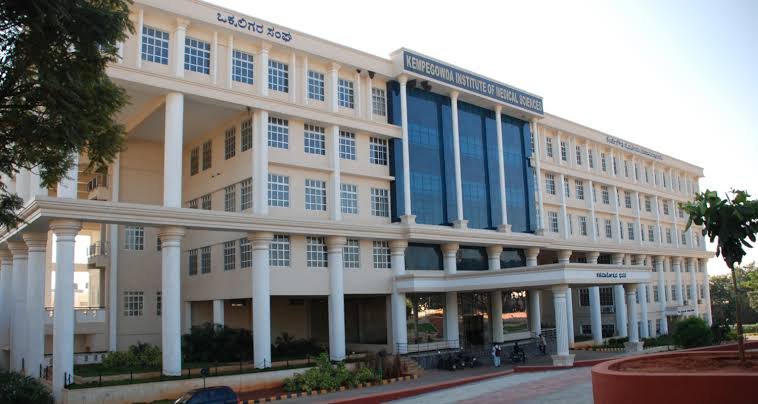
KIMS Hospital and Research Centre is probably not the KIMS most people outside Karnataka picture when they hear the name. This is the teaching hospital of the Kempegowda Institute of Medical Sciences, an institution of more than 1,100 beds on K.R. Road in V.V. Puram, in old Bengaluru. It sits a short walk from the crowded lanes of K.R. Market and has been treating the city’s residents since 1990. The Vokkaligara Sangha, a community organisation founded in the early 1900s, runs both the hospital and its medical college. For decades, families from Bengaluru and the surrounding districts have come here for affordable treatment across nearly every speciality.
| Quick Facts | Details |
| Full name | KIMS Hospital and Research Centre (Kempegowda Institute of Medical Sciences Hospital) |
| Address | K.R. Road, V.V. Puram (Visveswarapuram), Bengaluru, Karnataka 560004, India |
| Landmarks | Opposite Bangalore City Institute; next to the Vokkaligara Sangha building (Nadaprabhu Kempegowda Bhavan); near Makkalakoota Circle |
| Neighbourhoods around | V.V. Puram, Basavanagudi, Shankarapura, Chamrajpet, K.R. Market |
| Managed by | Vokkaligara Sangha, Bengaluru |
| Hospital established | 1990 |
| Medical college established | 1980–81 (classes began 16 March 1981, now marked every year as KIMS Day) |
| Affiliated university | Rajiv Gandhi University of Health Sciences (RGUHS), Karnataka |
| Type | Private teaching hospital, multi-speciality |
| Bed capacity | About 1,100 beds |
| Super speciality services | Cardiology, Neurology, Neurosurgery, Gastroenterology, Surgical Gastroenterology, Nephrology, Urology, Endocrinology, Oncology (surgical and medical), Plastic Surgery, Paediatric Surgery, Vascular Surgery, Intensive Care |
| Round-the-clock services | 24-hour pharmacy, blood bank, emergency care |
| Imaging | CT, MRI, X-ray, ultrasound |
| Special services | Dialysis, ART centre, TB treatment, kidney stone removal, pain management, physiotherapy, nutrition and diet, body donation, mortuary |
| Academic programmes | MBBS, MD/MS, postgraduate diplomas, paramedical courses |
| Hospital phone | 080-26620036 / 080-26673056 |
| kimshospitalbangalore@gmail.com | |
| Nearest metro stations | National College and Krishna Rajendra Market (Green Line) |
| Nearest major railway station | KSR Bengaluru City (Majestic), around 4 km |
| Nearest airport | Kempegowda International Airport, around 40 km (1 to 1.5 hours or more by road) |
| Time zone | IST, UTC+5:30 (no daylight saving) |
| Official website | kimsbangalore.edu.in |
A Community Trust Behind a Medical College
The Vokkaligara Sangha has run schools and colleges in Karnataka for more than a century, including the Bangalore Institute of Technology. In 1979, it formally decided to open a medical college. The then Chief Minister, R. Gundu Rao, laid the foundation stone on 30 November 1980, and the first MBBS batch started classes in March 1981.
The college works across two campuses. Pre-clinical subjects like anatomy and physiology are taught at the Banashankari 2nd Stage campus. Clinical teaching, where students learn at the bedside, happens at the V.V. Puram hospital. The hospital followed in 1990 and has since grown into one of the larger private teaching hospitals in the city.
Getting to V.V. Puram
The hospital sits in the dense older core of southern Bengaluru, so public transport is often easier than driving.
Namma Metro: Two Green Line stations are close by. National College station is the most convenient for most visitors, and Krishna Rajendra Market station works if you are coming from the Majestic side. Both are a short walk or auto ride from the hospital gate.
Train: KSR Bengaluru City station, known locally as Majestic, is about 4 km away. The Green Line connects Majestic (Nadaprabhu Kempegowda station) to the stops near the hospital in a few minutes.
Bus: K.R. Market is one of the city’s major bus hubs, with BMTC services arriving from nearly every part of Bengaluru.
Airport: Kempegowda International Airport is on the far northern edge of the city, about 40 km away. Plan for at least an hour and a half in normal traffic.
Car: Parking in the hospital basement is reserved for doctors, and street parking around K.R. Road is tight. Unless someone can drop you off, a cab or metro is the better option.
Floor Plan: Where Each Department Sits
The hospital building has an Eastern block and a Western block. Knowing the layout before arriving saves a lot of wandering, especially for elderly patients.
| Floor | Eastern Block | Western Block |
| Ground | Medicine department, radiology, offices of the Dean, Principal, Medical Director, and Medical Superintendent | OPDs for Medicine, Orthopaedics, Dermatology, Community Medicine, Dental, and Obstetrics & Gynaecology |
| First | Medicine wards | OPDs for Surgery, ENT, Paediatrics, and super specialities; Dialysis Centre; ART Centre |
| Second | Surgical wards | KIMS Heart Centre with ICCU and cath lab; Psychiatry |
| Third | Obstetrics & Gynaecology wards, labour rooms, and OT | Special (private) wards |
| Fourth | Main operation theatre complex and CCU | Orthopaedics department |
| Fifth | Paediatric wards, NICU, and PICU | Ophthalmology, ENT, and Dermatology |
| Sixth | — | Auditorium, lecture halls, seminar hall, library |
A simple rule of thumb: the Western block is where you consult, and the Eastern block is where you get admitted. Most OPD visits start on the Western side’s ground or first floor.
Departments and Specialities
Broad Specialities
These are the core departments that every medical college hospital must run. At KIMS they include General Medicine, General Surgery, Obstetrics and Gynaecology, Paediatrics, Orthopaedics, ENT, Ophthalmology, Dermatology, Psychiatry, Anaesthesiology, Dentistry, Radiology, and Community Medicine. Pathology, Microbiology, and Biochemistry labs support them, and the hospital also has a forensic post-mortem facility.
Super Specialities
The hospital’s advanced services include:
- Cardiology, based at the KIMS Heart Centre with an intensive coronary care unit and a catheterisation lab for angiography and angioplasty
- Neurology and Neurosurgery, for stroke, seizures, head injuries, and brain and spine surgery
- Gastroenterology and Surgical Gastroenterology, covering endoscopy, liver disease, and digestive tract surgery
- Nephrology, with an in-house dialysis centre
- Urology, including kidney stone removal
- Endocrinology, for diabetes, thyroid, and hormonal disorders
- Surgical and Medical Oncology, for cancer surgery and chemotherapy
- Plastic Surgery, for burns, reconstruction, and cosmetic work
- Paediatric Surgery, for surgical conditions in infants and children
- Vascular Surgery, for arteries, veins, and diabetic foot complications
- Intensive Care, with adult, cardiac, neonatal, and paediatric ICUs
Diagnostic and Special Services
Some of KIMS’s services run around the clock, and others fill needs that many private hospitals don’t cover.
- 24-hour pharmacy, useful for late-night prescriptions and emergency needs.
- Blood bank, supporting surgery, trauma, obstetrics, and dialysis patients.
- Imaging, including CT, MRI, X-ray, and ultrasound, based in the radiology department.
- Dialysis centre, for patients with chronic kidney failure on regular dialysis.
- ART centre, providing antiretroviral therapy for people living with HIV.
- Anti-tubercular therapy, for tuberculosis treatment and follow-up.
- Pain management, for chronic pain, cancer pain, and post-surgical recovery.
- Physiotherapy, for rehabilitation after surgery, fractures, or stroke.
- Nutrition and diet counselling, for diabetes, kidney disease, and recovery diets.
- Body donation programme, for people who want to donate their body for medical education after death.
- Mortuary services, including post-mortem facilities.
- Community services, including outreach health camps run through the Community Medicine department.
On-site amenities are basic but practical: a full canteen for patients’ families and a KIMS co-operative society store inside the hospital.
What a Teaching Hospital Means for You as a Patient
Choosing a medical college hospital is a different experience from walking into a corporate hospital. It helps to know what to expect:
- Costs are usually lower. Consultations, tests, and ward stays at teaching hospitals like KIMS generally cost noticeably less than at corporate chains in the city.
- Several doctors will see you. Junior residents often take the first history, and senior faculty lead diagnosis and treatment decisions. The questions may feel repetitive, but you get more eyes on your case.
- Students are part of rounds. Medical students may observe or examine patients under supervision. You can politely decline if you are uncomfortable.
- The OPD is busy. The general OPD often has long queues, especially on Monday mornings. Private or special consultations, where offered, tend to move faster.
- Unusual cases get attention. Teaching hospitals see a wide range of conditions, and faculty are often keen on complex or rare cases.
Before You Head to K.R. Road
- Arrive early for OPD. Registration counters get crowded as the morning goes on.
- Carry a photo ID and all previous reports. Old scans, prescriptions, and discharge summaries help doctors and avoid repeat tests.
- Know your department before you arrive. Use the floor plan above, since signs can be hard to follow at busy times.
- Ask about room categories at admission. General wards and special wards on the Western block’s third floor cost very differently.
- Confirm insurance and government scheme coverage at the billing desk before planned procedures.
- Double-check the “KIMS” name on referral letters and insurance forms, for the reasons explained earlier.
- Use the metro during peak hours.R. Road and the market area get heavily congested in the mornings and evenings.
Frequently Asked Questions
Q1. What is the address of KIMS Hospital Bangalore?
K.R. Road, V.V. Puram, Bengaluru, Karnataka 560004, opposite Bangalore City Institute.
Q2. Is KIMS Hospital Bangalore the same as KIMS Hospitals in Mahadevapura?
No. KIMS V.V. Puram is the Kempegowda Institute’s teaching hospital, while Mahadevapura belongs to the Krishna Institute of Medical Sciences chain.
Q3. Who runs KIMS Hospital and Research Centre?
It is managed by the Vokkaligara Sangha, which also runs the Kempegowda Institute of Medical Sciences.
Q4. How many beds does KIMS Hospital have?
The hospital has about 1,100 beds.
Q5. Which metro station is closest to KIMS Hospital?
National College station on the Green Line is the most convenient, and K.R. Market station is also nearby.
Q6. Does KIMS Hospital have a dialysis unit?
Yes. The dialysis centre is on the first floor of the Western block.
Q7. Is there a heart centre at KIMS Hospital?
Yes. The KIMS Heart Centre, on the second floor of the Western block, has an ICCU and a cath lab.
Q8. Does KIMS Hospital have a 24-hour pharmacy?
Yes. The pharmacy and the blood bank both operate round the clock.
Q9. What is the phone number of KIMS Hospital Bangalore?
The hospital lines are 080-26620036 and 080-26673056.
Q10. Which university is KIMS Bangalore affiliated with?
It is affiliated with the Rajiv Gandhi University of Health Sciences, Karnataka.