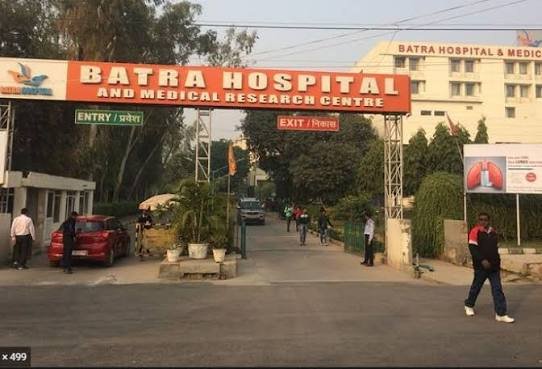
Batra Hospital and Medical Research Centre opened in 1987 as the first multi-speciality private hospital in Delhi, at a time when most of the city’s tertiary care was still concentrated in government institutions like AIIMS and Safdarjung. Nearly four decades later, the 500-bed hospital on Mehrauli-Badarpur Road remains a major referral point for South Delhi, Faridabad, Gurugram, and patients who travel from neighbouring states and countries. It runs under the Ch. Aishi Ram Batra Public Charitable Trust and treats patients across more than 40 specialities, with particular depth in heart care, cancer, neurosciences, orthopaedics, and kidney disease.
| Quick Facts | Details |
| Full name | Batra Hospital & Medical Research Centre |
| Official address | 1, Tughlakabad Institutional Area, Mehrauli-Badarpur (M.B.) Road, New Delhi 110062, India |
| Area references | Tughlakabad Institutional Area, near Vayusenabad and Sangam Vihar, South Delhi |
| Established | 1987 |
| Run by | Ch. Aishi Ram Batra Public Charitable Trust |
| Type | Private, multi-speciality tertiary care hospital |
| Distinction | Delhi’s first multi-speciality private hospital |
| Bed capacity | 500 beds |
| ICU beds | Around 110 |
| Operation theatres | 14 |
| Specialities | 42 |
| Centres of excellence | 8 (Heart, Neurosciences, Ortho & Joint Replacement, Gastrosciences, Urology, Pulmonology & Sleep Medicine, Dialysis & Kidney Transplant, Cancer) |
| Accreditations | NABH (hospital), NABL (laboratory) |
| Emergency | 24×7, with trauma centre and resuscitation unit |
| Emergency / appointment line | +91 75201 32013 |
| Landline | 011-43333737 |
| +91 85957 78376 | |
| appointment@batrahospitaldelhi.org | |
| Ward visiting hours | Mon–Sat 5–7 PM; Sunday 10 AM–12 PM and 5–7 PM |
| ICU visiting hours | Mon–Sat 11–11:30 AM and 6–6:30 PM |
| MICU visiting hours | Mon–Sat 11:30 AM–12 PM and 4:30–5 PM |
| EWS free treatment | Available under Delhi’s free-bed scheme for economically weaker sections |
| Nearest metro | Saket (Yellow Line) |
| Nearest major railway station | Hazrat Nizamuddin |
| Nearest airport | Indira Gandhi International Airport, around 17 km (45 minutes to over an hour by road) |
| Time zone | IST, UTC+5:30 (no daylight saving) |
| Official website | batrahospitaldelhi.org |
One Hospital, Two Pin Codes
Search online for the hospital’s address and you’ll run into an annoying inconsistency. The hospital itself uses New Delhi 110062, while several directories and map listings show 110044 and describe the location as Vayusenabad or Tuglakabad. Both point to the same building on M.B. Road. For couriers, insurance paperwork, and medical visa documents, stick to the hospital’s official version: 1, Tughlakabad Institutional Area, M.B. Road, New Delhi 110062.
When giving directions to a cab driver, “Batra Hospital, M.B. Road” works better than the full institutional-area address. Nearly every driver in South Delhi knows it by name.
How to Get There
Mehrauli-Badarpur Road is one of South Delhi’s busiest arterial roads, and traffic around the hospital can slow considerably in the morning and evening peaks. Plan with that in mind.
Metro: Saket station on the Yellow Line is the stop most visitors use. From there, an auto-rickshaw or e-rickshaw ride along M.B. Road takes around 10 minutes outside peak hours.
From the airport: Indira Gandhi International Airport is roughly 17 km away. By car, expect about 45 minutes in normal traffic and over an hour during rush hour. Overseas patients should ask the international patients team about pickup arrangements before landing.
By train: Hazrat Nizamuddin and New Delhi are the main long-distance stations. Nizamuddin is closer, and a cab from there typically takes 30 to 45 minutes.
From Gurugram and Faridabad: Both are within practical driving distance, which is why a large share of Batra’s patients come from outside Delhi proper. Mathura Road and M.B. Road connect the hospital to Faridabad, while the Mehrauli-Gurugram Road serves the Gurugram side.
The Eight Centres of Excellence
Batra organises its most specialised work into eight named centres. These are the departments that handle the complex referral cases.
Batra Heart Centre
The cardiac programme covers diagnostic testing (ECG, echocardiography, CT coronary angiography, cardiac MRI), catheterisation, angioplasty, and bypass surgery. It also offers EECP (enhanced external counterpulsation), a non-invasive option for some angina patients who are not suitable for surgery. Prof. (Dr.) Upendra Kaul, a well-known interventional cardiologist, heads the centre.
Batra Neurosciences Centre
This centre handles stroke, epilepsy, Parkinson’s disease, dementia, multiple sclerosis, and brain aneurysms, along with neurosurgery for tumours and spinal conditions.
Batra Ortho & Joint Replacement Centre
Knee and hip replacements, arthroscopy, fracture care, and sports injuries make up most of the work here.
Batra Gastrosciences Centre
This centre covers medical gastroenterology, endoscopy, liver disease, and gastrointestinal surgery under one team.
Batra Department of Urology (Nephro-urosciences)
The department treats kidney stones, prostate enlargement, urological cancers, and related conditions using endoscopic and laser techniques.
Batra Advance Pulmonology, Critical Care & Sleep Medicine Centre
This unit treats asthma, COPD, tuberculosis, and interstitial lung disease, and runs a sleep medicine service. Sleep apnoea often goes undiagnosed for years in people who simply think they snore.
Batra Dialysis and Kidney Transplant Centre
This centre provides haemodialysis for chronic kidney disease and carries government approval for kidney transplantation.
Batra Cancer Centre
The cancer centre brings surgical oncology, radiation oncology, and medical oncology together, along with haematology for blood cancers and blood disorders. Having all three treatment arms in one building spares patients a great deal of running around.
Other Departments
Beyond the eight centres, Batra runs a broad set of departments:
- Surgery: General and laparoscopic (minimal access) surgery, vascular and endovascular surgery, and plastic, cosmetic and reconstructive surgery with a hand clinic
- Women and children: Obstetrics, gynaecology and IVF; paediatrics, neonatology, paediatric nephrology and paediatric surgery
- Medicine: Internal medicine, endocrinology and diabetology, dermatology and cosmetology, psychiatry and clinical psychology
- Senses and head: ENT and head-neck surgery, ophthalmology, dentistry and maxillofacial surgery
- Recovery and support: Physiotherapy, physical medicine and rehabilitation, speech and audiology, dietetics and nutrition
- Hospital-wide: Anaesthesiology with a pain clinic, emergency medicine, radiology and imaging, laboratory medicine, and blood bank
- Alternative medicine: A homeopathy service, which is unusual for a tertiary private hospital
Round-the-Clock Services
Several services at Batra run 24 hours a day and matter most in an emergency.
- Emergency and trauma: The emergency wing has a dedicated trauma centre, its own operation theatres, an observation ward, a resuscitation unit, and a labour room.
- Critical care: The ICU network includes a 27-bed medical ICU with ventilator support, plus a paediatric ICU and an observation nursery.
- Ambulance: The hospital operates its own ambulances for pickups and transfers.
- Blood centre: On-site blood bank supporting surgery, trauma, and cancer treatment.
- Pharmacy: In-house pharmacy for inpatients and discharge prescriptions.
- Diagnostics: NABL-accredited laboratory, CT, MRI, ultrasound, X-ray, and nuclear imaging.
- Health check-ups: Preventive screening packages through a dedicated health check department.
Free Treatment for Economically Weaker Sections
This is one of the least-known facts about Batra Hospital. Delhi requires private hospitals built on land allotted at concessional rates to treat patients from economically weaker sections (EWS) for free. Under the rules, 10% of inpatient beds and 25% of outpatient consultations must be reserved for eligible patients at no cost. Batra publishes its EWS compliance on its website.
In practice, this means:
- Families that meet Delhi’s EWS income criteria can seek free consultations and admission.
- Proof of income and residence is usually required, so carry documents on the first visit.
- Many hospitals run a dedicated EWS desk or nodal officer. Ask at the reception rather than the general billing counter.
- Medicines and consumables have their own rules, so confirm what is covered before admission.
Many families who qualify never ask, simply because they don’t know the scheme exists. Hospitals are not required to advertise it loudly, so asking directly makes a real difference.
Visiting Hours
Batra’s visiting windows are shorter and more tightly split than at many private hospitals, especially in intensive care.
| Area | Days | Timing |
| Wards | Monday to Saturday | 5:00 PM – 7:00 PM |
| Wards | Sunday | 10:00 AM – 12:00 PM and 5:00 PM – 7:00 PM |
| ICU | Monday to Saturday | 11:00 AM – 11:30 AM and 6:00 PM – 6:30 PM |
| MICU | Monday to Saturday | 11:30 AM – 12:00 PM and 4:30 PM – 5:00 PM |
ICU and MICU windows last only 30 minutes each. Relatives travelling from outside Delhi should time their arrival carefully, because showing up at 1 PM means waiting several hours. Sunday ICU timings are not published, so call ahead before visiting on a Sunday.
Insurance, Corporate Panels, and Payment
Batra works with a list of empanelled companies and third-party administrators (TPAs). The hospital publishes both lists on its website. For planned treatment, check three things early:
- Whether your insurer or TPA is on the current list.
- Whether your policy allows cashless treatment at this hospital specifically.
- What room category your policy covers, since a higher room category can raise the entire bill proportionally under many Indian policies.
The hospital also offers a privilege card programme for regular patients, and appointments can be booked online, over the phone, or on WhatsApp.
Training, Research, and Community Work
The “Medical Research Centre” part of the name refers to real academic activity. Batra is recognised for postgraduate medical training under the National Board of Examinations, and it runs nursing education and allied health courses.
One project stands out. The Sanjay Batra Memorial Centre produces 3D-printed hand prostheses for people who have lost fingers or hands, often in industrial accidents. For a manual worker, a functional prosthetic hand can mean the difference between returning to work and losing a livelihood. It is a small programme, but it shows the trust’s charitable side more clearly than any brochure.
Mistakes Families Often Make
Years of patient experiences at large Delhi hospitals point to a few recurring problems that are easy to avoid:
- Going to the emergency wing for non-urgent care. It slows things down for everyone. Book an OPD appointment unless the situation is genuinely urgent.
- Missing the short ICU windows. Plan around the 30-minute slots rather than hoping for an exception.
- Not asking about EWS eligibility. Families who qualify often pay full price simply because they never asked.
- Leaving insurance approval to the day of admission. Start pre-authorisation as soon as surgery is scheduled.
- Arriving without previous reports. Old scans and discharge summaries save time and repeat tests.
- Underestimating M.B. Road traffic. Leave a buffer, especially for early-morning surgery reporting times.
Frequently Asked Questions
Q1. What is the address of Batra Hospital Delhi?
1, Tughlakabad Institutional Area, M.B. Road, New Delhi 110062.
Q2. Is Batra Hospital a government hospital?
No. It is a private, multi-speciality hospital run by the Ch. Aishi Ram Batra Public Charitable Trust.
Q3. When was Batra Hospital established?
It opened in 1987 and was the first multi-speciality private hospital in Delhi.
Q4. How many beds does Batra Hospital have?
It has 500 beds, including around 110 ICU beds, and 14 operation theatres.
Q5. Which metro station is nearest to Batra Hospital?
Saket on the Yellow Line is the most convenient, about a 10-minute auto ride away.
Q6. What is the Batra Hospital emergency number?
Call +91 75201 32013 for emergencies and appointments.
Q7. What are the ICU visiting hours at Batra Hospital?
Monday to Saturday, 11–11:30 AM and 6–6:30 PM.
Q8. Does Batra Hospital offer free treatment?
Yes. Eligible economically weaker section patients can get free treatment under Delhi’s EWS free-bed rules.
Q9. Does Batra Hospital perform kidney transplants?
Yes. Its Dialysis and Kidney Transplant Centre holds government approval for transplants.
Q10. Is Batra Hospital NABH accredited?
Yes. The hospital is NABH accredited and its laboratory holds NABL accreditation.